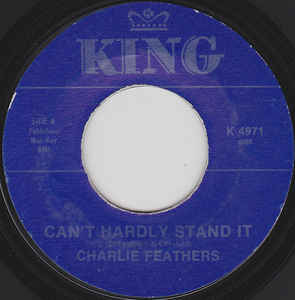
#18 Charlie Feathers – Can’t Hardly Stand It (1956)


Feathers was born in Mississippi in 1932, of Irish and Cherokee descent. Having started out as a session musician at Sun Studios, he eventually recorded a string of rockabilly singles on Sun Records, Flip, Holiday Inn, Meteor and King Records in the 1950s. (His best-known recordings were on Meteor and King). It has been said, (mainly by himself, admittedly), that his hiccuping vocal style was a direct influence on other contemporary vocalists, (although Buddy Holly would probably have disputed that claim). Feathers indeed talked big, and appeared to resent the fact that he was not more widely recognised as a rockabilly pioneer. He said of Buddy Holly, for example, that, “Buddy Holly would listen to me and he wanted to get on Sun, man. Then he went to Clovis, New Mexico and did `Peggy Sue’. A lot of people say we sound alike, but he heard me do the hiccup, so who copied who?” He once claimed also that he, “brought Elvis to Sun Records in 1953, man. Not only did I get him there, but I got him doing rockabilly. Bill Monroe had done `Blue Moon of Kentucky’ but I showed Elvis how to do it his way, so I arranged that record. I didn’t play on it but I was at the controls.” A bordering-on-scathing obituary of Feathers by The Independent upon his death in 1998 after a stroke-induced coma, compared his jealousy of Elvis’ success to that of Salieri’s jealousy of Mozart in the 18th Century, and that Feathers had grossly over-emphasised his role as an artist of influence. As they put it, “he [Feathers] was in Memphis at the crucial time, even if no one took much notice of him.” (Ouch)

Few of Feathers’ records were released in the UK, and none of his songs were picked up by the British beat groups of the early 1960s. He had been the victim of poor management, but was also reputed to be very difficult to work with. Sam Phillips of Sun Records, for example, claimed that Feathers could have been a major star were it not for his fractious personality.  It is undoubtedly the case, however, that Feathers was a direct influence on a later generation of musicians. Having been pretty much ignored until the 1970s, some neo-rockabilly fans in the UK rediscovered, (or should that be “discovered”?) him, creating a demand for his records. He became something of a cult hero of the rockabilly genre. The late lamented Lux Interior of the wonderful Cramps claimed, for example, that Feathers was an influence on his vocal style, and the band recorded cover versions of some of his songs. Other fans include Tav Falco’s Panther Burns. The Can’t Hardly Stand It  track, with its slightly menacing feel, and slower in tempo than a typical Feathers song, was recorded in 1956, and showcases his vocal style beautifully. One could easily imagine that the song had actually been penned and performed by The Cramps, and indeed, they recorded a cover version of it. It is startling, therefore, just how influential he actually turned out to be on a newer generation of performers, and this must be set against the unkind views of The Independent, and others. Eventually, there was a recognition of his pioneering contribution to the rockabilly genre when he was inducted into the Rockabilly Hall of Fame.
 

feathers


#17 Smith and Selway – 15.5 Remake (2000)

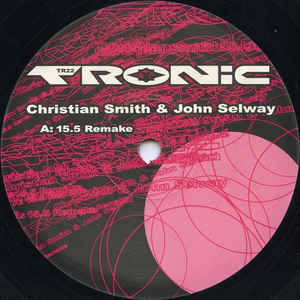
Straight-forward, ear-bludgeoning techno from the Swedish and American duo of Christian Smith-Solbakken and John Selway. Smith is a tech-house and techno DJ and producer, who began his house and techno label, Tronic, in 1994, then re-started it again in 2009, after a two-year hiatus. Selway has been heavily involved over a number of years since the 1990s in producing as a collaborator in many musical projects. It has been said of Selway that he, “has created and helped to create one of the most stylistically wide ranging bodies of work in the world of electronic dance music.” His first real success in the world of techno was as part of seminal New York duo, Disintegrator, but his most successful collaborations have been with Smith, as the duo “Smith & Selway”. Indeed, between 1999 and 2012, the duo have collaborated on 35 EPs and one album, which represents a pretty prolific volume of work. This one from 2000, 15.5 Remake, (superior to the more brutal 15.5 Edit on the other side), is a belter. It seems to encapsulate for me the sheer raw power, excitement, energy and threatening feel of well-produced techno. Like all techno, house, or disco, however, I implore you to listen to this at high volume on either a quality sound-system, (separates, powerful amps and speakers, etc. etc.),  or in the dome of privacy facilitated by high-quality headphones, (Sony MDRZX310 foldable ones should do the trick, fairly cheaply), otherwise it sounds tinny, repetitive and annoying.

R-76642-1357403158-3736.jpeg


#16 The Metros – Since I Found My Baby (1967)

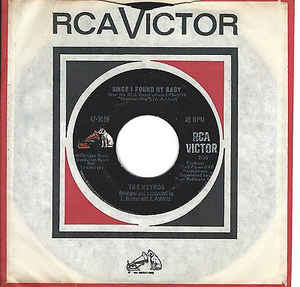
The Metros were a soul outfit from Detroit, and have been described as one of the least-known groups to have recorded on a major label – in their case, RCA Records. The group consisted of four members: Percy Williams (lead vocals), James Buckman, Robert Suttles, and Arthur Mitchell, and they released one album and three singles, in the 1966 to 1967 period. Their first single, Sweetest One (October 1966), was their most successful record, followed by this second, (superior, in my opinion), single, Since I Found My Baby, in March 1967. It’s a Northern Soul classic, with falsetto second tenor vocals, and showcases the genre’s heavy 4-4 beat and fast tempo, so ideally suited to the idiosyncratic flourishes of dancers on a well-sprung dance-floor. An original copy of this record would set you back at least £200.00, (have a look on Discogs), so thankfully, it appears on a plethora of Northern Soul compilations, and has come out as a vinyl reissue in 2011 on Outta Sight Records. (I got a copy of that one).

The Metros’ third RCA single, The Replacer b/w Let’s Groove, bombed, and ended the Metros time with RCA. A further two singles came out in 1967 and 1969 on Boss Records and 123 Records, (whose parent company was Capitol Records), respectively, but failed to make a significant impact, (even in Northern Soul circles).

metros

#15 Andy Starr and the Casinos – Just a Walkin’ (1960)

Known to his fans as ‘The Ultimate Rebel’, Andy Starr, born Franklin Delano Gulledge, in Arkansas in 1932, (named after the 32nd President of the USA, i.e. Roosevelt), was  a rockabilly musician. He was once described, unflatteringly perhaps, by Billboard as, “one of the more noteworthy Presley disciples.” (Gee, thanks Billboard). He had a colourful upbringing and adolescence, a childhood scarred by poverty culminating in his pulling a pistol out on a teacher, followed by a travelling, hobo lifestyle across the country, which he embarked on from the age of 14.  Starr eventually formed the Arkansas Plowboys with his brothers, Bob and Chuck, playing regularly in California until Starr headed for Dennison, Texas, where he got a slot at the KDSX radio station. The manager at KDSX advised him to seek out Joe Leonard, who owned the Lin record label in nearby Gainesville. Leonard was duly impressed, and a session recorded in early 1955 produced four songs. The first two Lin singles, Dig Them Squeaky Shoes“and Tell Me Why were credited to Frank Starr and his Rock-Away Boys. However, “Frank Starr” became “Andy Starr”, in order to avoid confusion with a country singer of the same name.

It was after sharing the stage with Elvis in Gainesville in April 1955 that Starr changed his style from honky-tonk to rockabilly. Joe Leonard saw a promising future for Starr, and tried to place him with a major label via a lease deal. He approached the influential Aberbach brothers, who took Starr to MGM. Eight songs came out on MGM in 1956 – the four Lin masters in August and another four in September. In spite of all the raw energy that these recordings evidenced, they were not successful, largely because of poor promotion. MGM had apparently wanted to nurture their own label’s version of Elvis, but didn’t want to pay the promotional and other costs involved, and sent out only 200 promo copies of each new release. In 1959 he single-handedly brought rock n roll to Alaska, with riotous live shows with his band, The Blue Notes. The owner of the Hi-Hat Club in Anchorage booked him for six months, but Starr, (now again calling himself “Frank Starr”), actually stayed there for five years in total. A strip act was apparently incorporated into his stage performance. Delightful.

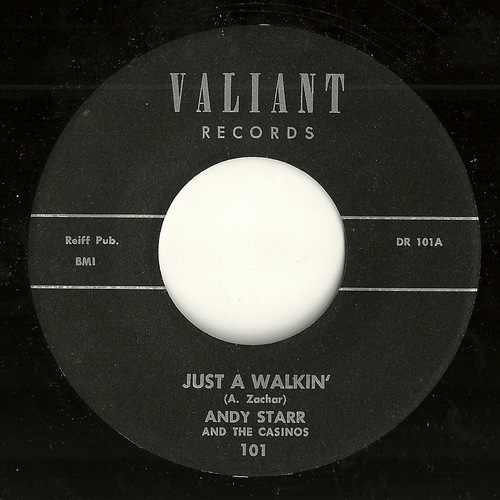
The Just a Walkin’ single was issued on Valiant Records in 1960, (and re-issued by Norton Records in recent years). It displays the classic rock n roll-influenced rockabilly sound of the time – Duane Eddy guitars and simple, plaintive lyrics about sweethearts, dances, and so on. The record is well-produced, with the just right mixture of rawness and musical competence that is the hallmark of many a good song. I love it. (Play loud).

Starr also recorded for other labels, recording one single and two tracks for Kapp in 1957 that were shelved, amazingly, until 1995, and one single for Holiday in 1961. He also returned to Lin in 1963 with a remake of Lin’s biggest hit, Ken Copeland’s Pledge of Love, but by now the rockabilly style had been abandoned in favour of a poppy, produced sound. Returning from Alaska in 1965, Starr spent most of the next 20 years in a maelstrom of alcohol and drug abuse, lots of sex, (he once claimed to have slept with more than 5,000 women), and weird religion. However, he recorded a handful of records for his own Starr label during this period, including a live album at Idaho State Penitentiary, a religious LP and a, frankly, X-rated album. He was still performing in the 1990s, and his final recordings were made in Nashville in mid-2002. He died in 2002 of complications from pneumonia, at the age of 70. He was one of these guys who should’ve been a star(r), but because of bad luck and bad choices by record labels and by himself, he wasn’t. Shame.

andy starr

Blog at WordPress.com.

Up ↑