#10 Huey Smith and His Clowns – Free, Single and Disengaged (1957)

Huey Pierce Smith, known as “Piano Smith”, was born in 1934 in Depression-era New Orleans, Louisiana. A rhythm and blues (R&B) pianist, whose sound epitomised the infectiously rollicking New Orleans, Professor Longhair-influenced R&B of the 1950s, he is considered to have been influential in the development of rock n roll. In 1957, he formed the band, Huey “Piano” Smith and His Clowns, with Bobby Marchan, signing a long-term contract with Ace Records. They had several chart hits in succession, including his most famous song, Rockin’ Pneumonia and the Boogie Woogie Flu, (a Top 5 R&B hit), and his biggest hit, Don’t You Just Know It / High Blood Pressure, (which reached the pop Top 10).  As a black musician from the Southern States, Smith’s career was nonetheless typically difficult and challenging. This included difficult tours of the segregated Southern States, and (the sadly common story of) unpaid royalties. In addition, his sound was probably too un-commercial to maintain a long, chart-successful music career, lacking the pop-crossover appeal of artists such as Fats Domino or The Coasters. The hits duly began to dry up, and when Marchan left the band in 1960, this signalled the beginning of the end of The Clowns. After a very brief period on Imperial Records, Smith returned for one, last hit on Ace, Pop Eye, in 1962. He spent the next few years touring with The Clowns, as well as the other groups that he formed, The Pitter Pats and The Hueys, but further success eluded him. He gave up the music industry after becoming a Jehova’s Witness.
huey

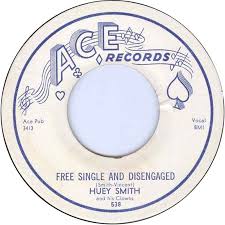
Free, Single and Disengaged is a typical, if less well-known, Smith song. It was the B-side to Just a Lonely Clown released on Ace Records in 1957. As well as being a great example of the New Orleans R&B sound of the time, marked by humour and nonsensical lyrics, an interesting thing to note is that it sounds very like an early Bo Diddley track, (e.g. the song, Bo Diddley), albeit with a significantly different arrangement. Was Bo listening to Huey’s songs prior to the release of his first album in 1958? Probably.

#9 Hasil Adkins – No More Hot Dogs (1955?)

There’s crazy, bat-shit-crazy, and then there’s Hasil Adkins. Hasil, pronounced “Hassel”, was born and raised in the Depression-struck state of West Virginia, USA, in 1937, and endured a childhood blighted by extreme poverty and lack of education. Nonetheless, he became a songwriter and multi-instrumentalist, performing his hardcore, stripped-down rockabilly numbers, usually as a one-man band. One element of the Adkins mythology includes the alleged misunderstanding of the songs he heard on the radio while growing up. As his sister Irene explained, “He heard Jimmie Rogers and Hank Williams on the radio, and he thought they was playing all those instruments themselves.” One of his earliest gigs included sharing the bill with The Collins Kids and Patsy Cline. He began recording  in the mid-1950s, exploring themes for his songs which included, zombies, peanut butter, sex, serial killers, and an obsessive love of poultry. In the mid-1960s, Adkins first official single, Chicken Walk / She’s Mine, was released in very small numbers through a tiny, local label, as were all his subsequent releases in this period.

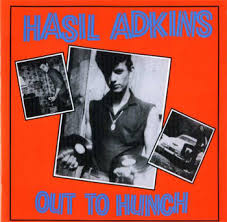
However, it wasn’t until the 1980s that his songs began to become known outside of his home State, (although he was by no means successful in West Virginia), and he soon acquired a cult following as the outsider’s outsider. Legendary punk and rockabilly band, The Cramps, recorded a remake of Adkins’ song, She Said, which brought his music to a much wider audience in 1983, on their Smell of Female album. This led to the creation of the Norton Records record label, which was formed by former Cramps drummer Miriam Linna and her husband Billy Miller specifically to re-issue Adkins’ back catalogue. This included the release of Out To Hunch, a compilation of Adkins’ songs from 1955-65.

adkins

No More Hot Dogs comes from this compilation. Typical Adkins fare, this dainty rockabilly number is about decapitating a girlfriend, and then keeping her head as a wall-mount. (As you do). The opening 20 seconds of laughing-policeman madness lets you know you’re in for a wild ride, and as the song proceeds, Adkins tells his recently decapitated girlfriend that, in addition to not being able to talk anymore, she “can’t eat no more hot dogs”. Quite. It’s wild, it’s mental, it’s rock n roll. I love it.

Although Adkins cited Elvis Presley and Hank Williams as key influences, the music he produced had a much more primitive, and a verging-on-deranged quality, and was a key influence on the punk rock/rockabilly mash-up genre of the early 1980s, psychobilly. Robert Palmer of The New York Times called Adkins’ songs,  “some of the most enthusiastically demented records in the annals of rock ‘n’ roll.” By Adkins’ own reckoning, he wrote around 7,000 songs, his creative juices stimulated and fuelled by his alleged two-gallon-per-day coffee habit, and a diet composed entirely of (often raw) meat. It was also a tradition of his to post a copy of each album he released to the sitting President of the time. In 1970,  Richard Nixon took the time to write back, and said, “I am very pleased by your thoughtfulness in bringing these particular selections to my attention.” The Guardian newspaper said this of Adkins in an obituary for him in 2005:

“His primitive sound and eccentric behaviour pulled in rockabilly, punk and ‘outsider’ audiences, but he was indifferent to the fact that many fans considered him a freak show; having sent out tapes of his songs over the decades to little or no response he was happy to have an audience”


#8 Iron Virgin – Rebels Rule (1974)

Iron Virgin were a Scottish glam rock band from Edinburgh, formed in 1972. Nick Tauber, who produced Thin Lizzy’s The Boys Are Back in Town, had scoured Scotland for a new band for the Deram label, a spin-off of Decca, and “discovered” the band at a local gig. Tipped for fame, and with a classic glam image, (big hair, ludicrously high platform boots and chastity belts), the band, however, were not sucessful, and recorded only two singles before disbanding. What went wrong?

Bad management and badly-judged song choice dealt a severe blow to the band before they even got going. When they first went into the studio with Tauber, they indicated that they wanted to release a song of their own as their first release. They were, however, strongly encouraged to record instead a glammy cover of Jet, originally recorded in 1973 by Paul McCartney’s Wings, from the album, Band on the Run, as their first single. This single was duly recorded and ready for release in December, 1973, but Decca delayed its release until February, 1974. This was a poor decision, because although the band enjoyed some success with this cover version, the single gaining some momentum in terms of sales, it was eclipsed by Paul McCartney’s own, original version, which was released as a single that very same month.

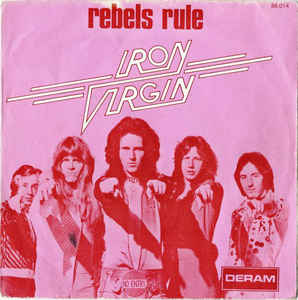
If the failure of their first single was down to bad management and song choice, the failure of their second single, Rebels Rule, (their own composition), also released in 1974, was a mystery. The song has been described by Billboard as, “A brilliantly bombastic ode to teenage anarchy; the single’s commercial failure is one of the great mysteries of its era”. It’s a stomping, pounding, fist-pumping glam anthem, the sort of song that Slade would have scored a Number One hit with, and with a chorus that the Bay City Rollers and indeed, the Ramones, would have killed for. It is frankly bewildering that it flopped. More puzzling still, is the fact that a variation of the song called, Stand Up for Kenny Everett, was often played on the BBC by the DJ, and so the tune must have been reasonably well-known to the radio audience.

Like many other such acts of the mid-70s era, however, Iron Virgin faded into obscurity until relatively very recently. This is because a critical reassessment of this period in music has taken place from the 2000s onwards, and many records of this type, (i.e. forgotten and obscure glam rock songs released on minor record labels), dubbed “Junkshop Glam”, have become  collectable. I suppose that the popularity of 1977 punk as a collectable category has entailed that it has now become an overly-mined seam, with few surprises or “discoveries” left, and collectors are constantly looking out for “the next big thing”. In this context, Junkshop Glam, particularly in the context of tracing the pre-1977 punk timeline, has become suddenly popular. Indeed, Rebels Rule is the first track on the excellent Velvet Tinmine compilation of obscure glam released by RPM Records in 2003. Other compilations of faded glitter acts also appeared around the same time, such as Glitter from the Litter Bin (2003), Glitterbest: UK Glam with Attitude 1971-76 (2004), and the curiously entitled, Boobs: The Junkshop Glam Discotheque (2005). These are all well-worth a listen, (despite some crap on them, it has to be said), as a starting-point for the Junkshop Glam genre.

iron

Because of their relative scarcity, some Junkshop Glam records, including the Rebels Rule single, are very difficult to get a hold of in good condition, and fetch high prices on eBay and Discogs, amongst other online marketplaces. I, myself, paid over-the-odds for the French version of this single, (see above), an impulsive and overly-generous late bid on eBay. I would instead recommend readers that if they want to track down Iron Virgin records, that they buy a copy of Rave-Up records of Italy’s excellent 2007 compilation of Iron Virgin’s songs in 2007, called 1974 Scottish Glam Rock.

Stay tuned for a special Junkshop Glam article soon.

#7 Dillard and Clark – Polly (1969)


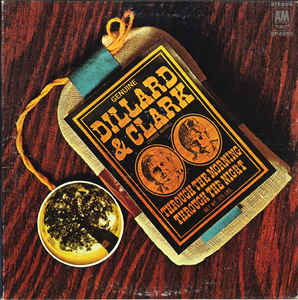
Doug Dillard, along with the song-writing genius that was ex-Byrd, Gene Clark, composed this haunting song, from Dillard and Clark’s second (and final) album, Through the Morning, Through the Night (1969). The group itself was formed in 1968, shortly after Clark departed The Byrds, and Dillard left the somewhat eponymous, Dillards. They were considered to be part of the burgeoning Southern California country-rock scene of the late 60’s, along with artists such as Gram Parsons, The Flying Burrito Brothers, Buffalo Springfield and Michael Nesmith. This song is an example of this scene’s song-writing at its finest, and if there is a more spine-tingling and beautiful first line to a country rock song, then I have yet to hear it. I have to say that the country rock genre holds, in general, very little appeal for me, but this song (and others by Dillard and Clark), and the work of that other country rock genius, Gram Parsons, remain amongst some of my favourite recordings ever. Full stop.

polly

It is a crime that this relatively short-lived duo’ s recording output is not much better known and appreciated than it is. However, it is a tragedy that Gene Clark did not achieve the degree of success or recognition that his song-writing deserved, post-The Byrds, before his descent into alcoholism and untimely demise at the age of only 46.

Blog at WordPress.com.

Up ↑