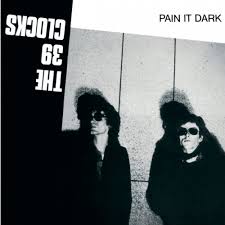
The 39 Clocks were a hugely underrated duo of musicians from Hannover, Germany, whose first public appearance was in 1976 at the Dada Nova in Hannover, a space occupied by the radical AAO Commune. They split in 1983, after recording three albums. Gigs were characterised by Situationist violence and the wilful and chaotic unprofessionalism of the band, but their recorded material was superb. With 1960s garage punk and psychedelic influences, their music also captures the sound of the Velvet Underground at their most dissonant, and the hauntingly spare electronica of legendary pioneering synth-punks, Suicide, (who were clearly a massive influence on them, adopting the New York duo’s confrontational aesthetic). The result is a minimalist Joy Division/ Cabaret Voltaire/ proto-goth noise, which makes it all the stranger that they remain so obscure to this day. They were often, unfairly, and much to the band’s annoyance, referred to simply as the “German Velvet Underground”, when it is pretty obvious that they took on a lot of influences and forged their own sound, as part of what was dubbed “new German psychedelia”.
This song appeared on the band’s first album in 1981, Pain It Dark, and undoubtedly provides the trancey, cascadingly repetitive, minimalist psychedelic template for a host of imitators, such as Spacemen 3, Loop and the Telescopes, to name but a few. Great track.
This Edinburgh-based band, led by Paul Haig, and named after the protagonist of Frank Kafka’s novel, The Trial, were signed to the legendary and effortlessly stylish Postcard Records label of Glasgow. The label proclaimed with breathtaking assuredness that it was the “Sound of Young Scotland” during its short existence between 1979 and 1981, and became the benchmark of indie-cool. Josef K indeed remain, to this day, the quintessential embodiment of an art-school-meets-literate-post-punk-chic – narrow suits, skinny ties, spiky hair, and well-read. (Just ask Franz Ferdinand, who have clearly embraced the Josef K aesthetic). Always, however, in the long post-punk shadow cast by their more well-known and commercially accessible label-mates, Glaswegian band Orange Juice, Josef K were heavily influenced by the art-punk of bands like Televison and Pere Ubu, and the dissonance and experimentation of short-lived New York No Wave movement of the late 1970s, which rejected even punk rock as cliched. The band, however, broke-up in August, 1981, because of a combination of factors – unfulfilled early promise, poor financial returns, a dislike of touring, and disagreements over future direction being chief amongst them.
This song, released in 1980, was their third single, and appears on the only studio album released during their existence, The Only Fun in Town (1981). It combines a strong feeling of reflective melancholy with an air of impending menace, and is a typical Josef K song – jangling guitars on the brink of atonality, emotionless vocals, thought-provoking and cryptically ambiguous lyrics, full of metaphor and imagery. The single version has an immediacy and more spontaneous feel to it than the version that appears on the album, and that is the version that I include here. Though a less up-tempo track than was usual for the band, it remains a great place to start to get to know Josef K.
I never used to “get” Northern Soul. Anytime I heard a Northern Soul record, I would think to myself, “What the **** is so good about that?” To me, they were simply unheard-of, formulaic, sub-Motown dancers – the sorts of tracks that Otis Redding or The Temptations would have discarded first when recording an album, because they weren’t anywhere good enough to make the final cut. I had therefore come to the conclusion that the reason Northern Soul artists, (and the small record labels to which they were signed), had remained so obscure in their own recording lifetimes, was that they were all crap. Simple.
There wasn’t any, one “eureka” moment on my conversion to ardent Northern Soul fan, but I suppose there were two things which began a slow-burn of opinion change. The first was stumbling upon Steve Parker’s wonderful Northern Soul Top 500 List website (http://rocklistmusic.co.uk/steveparker/northern_soul_top_500.htm), and starting tentatively to listen to the tunes listed, whilst off from work on a period of sick leave. This act, initially the result of boredom and musical curiosity, unlocked some kind of musical door for me, and over the period of the week, I must have listened to all 500 songs at least twice. I began taking note of the songs that I really liked, and soon had a list in excess of 200 songs.
The second game-changer for me was seeing Tony Palmer’s short 1976 film, The Wigan Casino on DVD, which supplied video for my fledgling Northern Soul audio adventure. I saw clearly for the first time how exciting the youth movement which formed around Northern Soul was, the film focussing on the all-nighters held at the mecca of Northern Soul, the Wigan Casino. I marvelled at the amphetamine-fuelled dancers’ athletic moves on the crowded dancefloor, their scene-specific clothing, the superb soundtrack to their sweaty gyrating, and the frenetic record buying and swapping that happened at these events. I began to wish that I could have been part of the scene (I was born too young). I “got” it.
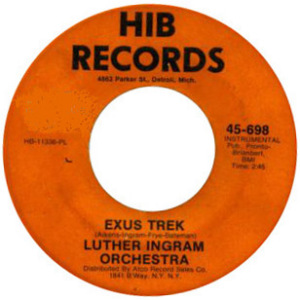
This record from 1966, by the Luther Ingram Orchestra, is one of the first Northern Soul songs that I really liked. It is the b-side instrumental version of the a-side single, If It’s All the Same to You Babe, on Hib Records, (I could have selected either version), and bears the hallmarks of the Northern Soul sound – the dance-friendly, typically heavy beat and fast tempo of mid-1960s Motown. It sounds amazing if you blast it out of your stereo at a Spinal Tappy volume 11, feeling the beat pulsating through your floor, and imagining yourself on a crowded 1970s dancefloor somewhere in the North of England. It is a record that ticks the main box for inclusion in the Northern Soul scene of the early 1970s, namely that it had had no significant, mainstream commercial success at the time it was originally released. (Although, because of the song’s subsequent popularity as a Northern Soul classic, it has been re-released a few times, and is easy to track down). In fact, Ingram’s first three releases all failed to chart, although he started to enjoy more success from the late 1960s onwards.
The Jesus and Mary Chain were formed in East Kilbride, Scotland, in 1983, by the fractious songwriting partnership of brothers, Jim and William Reid. In fact, the Reid brothers’ relationship could be even marked by explosions of physical violence. Despite this, and influenced by a variety of artists, including the Velvet Underground, the Stooges, the Shangri-Las, Suicide, Einsturzende Neubauten and early Pink Floyd, their feedback-drenched but sweetly melodic first album, Psychocandy, was released to massive critical acclaim.
Released in 1995, and appearing on the Mary Chain’s Munki album (1998), I Hate Rock n Roll is a wonderfully acerbic, spite-filled and withering attack on commercial and corporate aspects of the music business, and the media coverage that the band “enjoyed”. It radiates the immediacy and rawness of a live recording, with a one-take, cathartic feel. It has to be one of my favourite Jesus and Mary Chain tracks. The album is largely ignored in discussions about the band’s career and discography, the perceived wisdom being that the Mary Chain were on a gradual downward slide ever since the release of the stunning debut, Psychocandy. Generally, this is true, but there are huge high points on every album they ever released. And this is one of them. Written at a time when the Reid brothers were barely talking to each other, (in fact they recorded their parts separately), the album mirrors this dichotomy and division by the inclusion of another track, I Love Rock n Roll, written by Jim Reid, as a counterpoint to William Reid’s I Hate Rock n Roll. Their trademark early sound of skirling feedback was even forged as a result of conflict – at the sound check before their first London gig. Jim was apparently furious at the wall of feedback emerging from William’s amplifier, a “mistake” that would soon become their trademark sound.
After disbanding in 1999, the band reunited in 2007. The new 2017 album’s title, Damage and Joy, seems to capture this bitter-sweet essence of what it is to be in the band.





 Music You Should Hear